Bologna and Hellas Verona present new stadium projects for EURO 2032
Quick summary
Bologna and Hellas Verona have unveiled plans for new stadium projects as part of Italy's preparations to co-host EURO 2032.
Full article
Attributed to original sourceBologna and Hellas Verona have release plans for new stadium projects, with both hoping to finish in time for hosting duties during EURO 2032.
The law changes and extra staff applied to the process, as well as the firm deadline to be ready for the European Championships of 2032 , have seen a flurry of activity around new stadium plans.
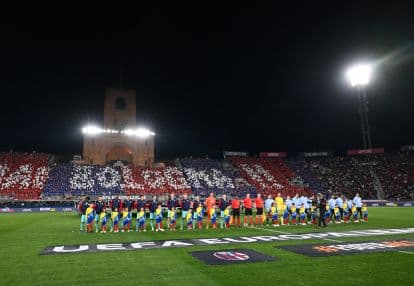
Bologna and Verona hope to host EURO 2032 games BOLOGNA, ITALY – APRIL 09: The teams line up prior to the UEFA Europa League 2025/26 Quarter-Final Leg One match between Bologna FC 1909 and Aston Villa FC at Stadio Renato Dall’Ara on April 09, 2026 in Bologna, Italy. (Photo by Alessandro Sabattini/Getty Images) Today Bologna announced they have united with BolognaFiere to build a new 35,000-seater stadium that will also be able to host concerts and other events.
That is helped by the fact the pitch can be moved off into a hidden compartment, allowing for events to take place without damaging the turf.
BOLOGNA, ITALY – MAY 24: Bologna fans show their support from the stands prior to the Serie A match between Bologna and Genoa at Stadio Renato Dall’Ara on May 24, 2025 in Bologna, Italy. (Photo by Alessandro Sabattini/Getty Images) The area in the north of the city had already been set aside for development by BolognaFiere, so plans were already in place to build a motorway exit ramp, train station and tram stop.
The statement notes that the total investment is expected to be around €300m.
Their plan is to open by Spring 2031. With the objective of hosting EURO 2032 fixtures.
VERONA, ITALY – JANUARY 04: Fans of Hellas Verona show their support by setting off flares and waving flags prior to the Serie A match between Hellas Verona FC and Torino FC at Stadio Marcantonio Bentegodi on January 04, 2026 in Verona, Italy. (Photo by Alessandro Sabattini/Getty Images) Also today, Hellas Verona presented their feasibility plan to the local council for the construction of a new stadium, which would involve knocking down the aging Stadio Bentegodi.
The investment here too would be €300m, mostly private funds from the club with a quota of public participation.
It would prevent it being a stadium used only for matchdays, so bringing in restaurants and retail space, including a Hellas Verona museum.
epa10911065 The UEFA Euro trophy is pictured after Italy and Turkey were elected to host the Euro 2032 fooball tournament during the UEFA EURO 2028 and 2032 hosts announcement ceremony at UEFA Headquarters, in Nyon, Switzerland, 10 October 2023. EPA-EFE/JEAN-CHRISTOPHE BOTT With construction expected to take three years, they are hoping to bolster the current Olivieri arena near to the Bentegodi in order to host Hellas games during the process.
That pitch would then be maintained after the stadium’s completion for use by the youth and women’s teams.
Source attribution: this article content is based on the linked publisher feed/source. Chance adds independent soccer context, impact analysis, entity links, and related news.
What happened
Bologna and Hellas Verona have both presented new stadium development projects aimed at meeting infrastructure requirements for Italy's role as a co-host of EURO 2032. The presentations outline modern venue designs and upgrades intended to bring the clubs' facilities in line with UEFA standards for the tournament. Both projects reflect the broader push across Italian football to modernize aging stadiums ahead of the competition, which Italy will share with Turkey. Details on timelines, funding, and construction phases are part of the plans now under discussion with local authorities.
Chance analysis
Italy's hosting duties for EURO 2032 have become a catalyst for long-overdue stadium modernization across Serie A. Bologna and Hellas Verona joining the wave of clubs presenting redevelopment plans signals that even mid-table and smaller-market sides are being pushed to meet UEFA's venue criteria. These projects will reshape matchday experience and commercial capacity at both clubs, though completion timelines and political hurdles around Italian stadium law remain the key obstacles to watch.
New stadium projects are a long-term positive for both Bologna and Hellas Verona in terms of infrastructure and commercial growth, but have no immediate effect on their on-field performance.