Collina: 'Not easy' to choose World Cup Final referee; ball didn't hit the cable in Norway vs England
Quick summary
FIFA referees chief Pierluigi Collina says selecting the referee for the World Cup Final is a complex decision, and confirmed that the ball did not strike a cable during the Norway vs England match.
Full article
Attributed to original sourceFIFA Chief Refereeing Officer Pierluigi Collina admits it ‘wasn’t easy’ to appoint the referee for the World Cup Final and insists: ‘It’s incredible that people can’t be convinced that a ball didn’t touch any cable’ during Norway vs. England.
Collina released an interview with Gazzetta dello Sport on the day of the 2026 World Cup Final between Spain and Argentina.
The former Italian referee officiated many big matches in his career, including the 2002 World Cup Final, in which Brazil beat Germany 2-0 thanks to a brace from Ronaldo.
Collina: Technology introduced to ‘resolve a paradoxical situation’ Regarded as the best referee of all time, Collina appointed Slavko Vinčić for tonight’s World Cup Final.
“He’s had a very good journey. I’m happy for him, as I am for the others who were here; making a choice wasn’t easy,” Collina said.
Vinčić broke into tears when learning that he had been picked to officiate the final.
“Every time I get goosebumps, I know what these men and women have done for years, sacrificing so much, including their families. I expected Vincic’s emotion; it was the same I experienced myself,” Collina said.
The former referee went on to talk about VAR and some of the most controversial decisions during this World Cup.
“Technology was introduced to resolve a paradoxical situation. In the stadium, over 80,000 spectators could see what happened on the pitch in real time, but the only person who couldn’t was the one who had to make the decisions,” he said.
“There were two paths: either we created an Amish community inside the stadium where technology was banned, or we gave the same opportunity to the referees. We invest millions, hoping, however, that they will be ‘thrown away’: that would mean the referees have done a good job and haven’t needed it.
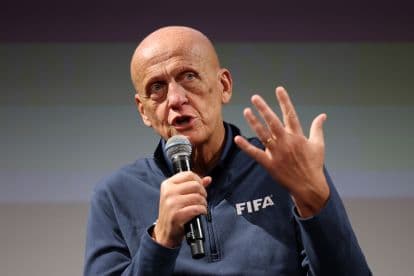
WASHINGTON, DC – DECEMBER 04: Chairman of the FIFA Referee Committee, Pierluigi Collina speaks at John F. Kennedy Center for the Performing Arts on December 04, 2025 in Washington, DC. (Photo by Dan Mullan/Getty Images) “From the 90s to today, football has changed. Players are different; the game is played at a much higher speed. And throughout all this, technology has played an important role, including for referees,” Collina continued.
“I remember the Brazil-Germany Final; when I asked the local Japanese staff if they could give me VHS tapes with videos of the two teams, they looked at me strangely. Today, there’s FIFA AI Pro, developed with Lenovo, which can provide useful information for preparation.”
One of the biggest controversies of the 2026 World Cup came in a quarter-final clash between England and Norway when the Three Lions scored the equaliser after the ball appeared to have hit a camera cable, changing its trajectory.
“It’s incredible that people can’t be convinced that a ball didn’t touch any cable… A graph was shown where, when a player or an object touches the ball, a peak is visible,” insisted Collina.
“In that case, a flat graph was seen from the moment the goalkeeper released the ball until the other player controlled it. There was only a slight wave, related to the air. The same applied to the ball’s rotations, and the camera also remained stable. There are technological tools that allow you to clarify certain things.”
The ball sensor was also instrumental in Portugal’s 2-1 win over Croatia, with the Croatians’ late equaliser disallowed for offside
“Here too, the graph was clear. There’s a peak when it touches the Croatian attacker’s head, then a flat line, and another peak when it touches the Portuguese defender’s back,” Collina said.
“Since the system doesn’t detect contact with hair, the peak is determined by contact with the head.”
Lastly, Collina insisted that VAR and technology in football improve the game rather than take emotions away from fans.
“That’s historically inaccurate. For offside, there’s a few seconds’ wait for confirmation, but the player celebrates when they score,” he said.
“And if the goal is confirmed, there’s a second celebration; if it’s disallowed, the opposing team celebrates. I find it much fairer that emotion is based on a correct decision, rather than an incident destined to be debated for weeks or decades. Even today, sixty years later, people still question whether, in England’s goal in the 1966 final, the ball truly crossed the line…”
Source attribution: this article content is based on the linked publisher feed/source. Chance adds independent soccer context, impact analysis, entity links, and related news.
What happened
Pierluigi Collina, head of FIFA's Referees Committee, addressed media on the challenges of appointing officials for the World Cup Final, emphasizing that the selection process is 'not easy' given the pressure and scrutiny involved. He also weighed in on a specific incident from the Norway vs England fixture, clarifying that the ball did not hit a cable, effectively dismissing what may have been a controversial talking point from that match. The comments underline FIFA's ongoing effort to maintain transparency and consistency in officiating at the highest level of the game.
Chance analysis
Collina's comments carry weight because the World Cup Final refereeing appointment is one of the most scrutinized decisions in football. His clarification on the Norway vs England incident also helps close a potential VAR/officiating debate, reducing lingering controversy around that fixture. For prediction systems, the main signal is reassurance that FIFA's officiating standards are being actively managed and explained, rather than a meaningful change in team-level expectations.
Neutral impact on competing teams; primarily reinforces confidence in FIFA's officiating framework ahead of the World Cup Final.
Refereeing governance commentary — no direct impact on team-level match predictions, but confirms standard officiating protocols are being upheld for upcoming World Cup fixtures.