How Serie A Is Closing the €1 Billion Gap With the Premier League
Quick summary
An analysis of Serie A's ongoing efforts to close the financial gap with the Premier League, focusing on revenue streams, broadcasting deals, and commercial growth strategies.
Full article
Attributed to original sourceSerie A and the Premier League both sell the same product. Elite football, top clubs, global stars. But the money each league pulls in from that product is far from equal. The Premier League’s broadcast income alone now runs several times higher than Serie A’s. Its current UK domestic rights deal is also worth roughly £1 billion more per year than Serie A’s current Italian deal. This shows how far apart the two leagues are in their core media markets.
This piece looks at where that gap comes from, why the Premier League keeps widening it, and what Serie A is actually doing about it.
The Financial Gap Between Serie A and the Premier League Serie A’s financial disadvantage is mainly a media and monetisation problem as much as a football one. The key question is why the Premier League has been so much better at turning global attention into revenue.
Where the €1 Billion Difference Comes From The clearest measure of the gap is broadcasting. Serie A’s current domestic media deal with DAZN and Sky is worth around €900 million per season, while the Premier League’s UK rights agreement for 2025/26 to 2028/29 is worth around £1.95 billion per season. That puts the difference between the two domestic markets at roughly £1 billion a year. The comparison is not perfectly like-for-like because the deals cover different markets and use different currencies, but it shows the scale of the Premier League’s advantage in its core media market.
The difference becomes even larger when all revenue streams are considered. Premier League clubs generated £6.8 billion in revenue during 2024/25, up 8% from the previous season. Broadcast revenue reached £3.4 billion, commercial revenue rose 13% to £2.4 billion, and matchday revenue passed £1 billion for the first time. Serie A clubs generated €3 billion in 2024/25, up 4%, with Juventus, Inter and Milan accounting for 45% of the league’s total revenue. The numbers show the €1 billion-plus issue isn’t limited to broadcasting. Serie A has a much smaller revenue base across the business, making its media and commercial growth crucial if it is to reduce the wider financial gap.
Why the Gap Matters on the Pitch Money follows rights revenue. Clubs with bigger broadcast income can pay bigger wages and outbid rivals for players. Deloitte’s 2026 report shows three Italian clubs, Inter, AC Milan and Juventus, sitting in the world’s top 20 revenue generators. Six Premier League clubs sit in the top ten. This imbalance is even more obvious during the transfer window in summer.
It also shapes club finances off the pitch. Juventus posted losses of about €58 million, and Roma posted losses above €50 million in a recent financial year, while Serie A’s domestic broadcast deal has actually fallen 8% below its 2018-2021 peak. Fewer clubs are profitable, and the ones that are, like Napoli and Atalanta, rely on smart squad management rather than broadcast windfalls.
Why the Premier League Still Owns the Global Media Advantage The numbers explain the effect. The next question is what causes it.
A More Valuable Domestic Rights Product The Premier League starts with a stronger domestic media market. Its current UK rights cycle covers 2025/26 to 2028/29, with around 270 live matches available each season across five packages. This used to be just 200. The structure lets several major broadcasters compete for rights while keeping many matches behind premium subscriptions.
The Premier League also has a large number of high-value fixtures. Manchester United, Liverpool, Manchester City, Arsenal, Chelsea and Tottenham can all generate major audiences. Likewise, it has strong competitive depth, which means matches involving clubs outside the traditional elite can attract global interest.
Serie A has plenty of major fixtures too. But its domestic rights market is smaller.
Its current five-year domestic agreement with DAZN and Sky covers the 2024/25 to 2028/29 seasons. The fixed value is around €900 million per season, with additional revenue-sharing mechanisms possible.
International Rights Are the Real Multiplier Domestic rights aren’t the only edge to consider. The Premier League has built one of the strongest international distribution networks in sport. For the 2025/26 to 2027/28 cycle, it has broadcasters and distribution partners across Europe, Asia-Pacific, Africa, the Middle East and the Americas. Its partners include NBC Sports in the United States, SuperSport in sub-Saharan Africa, beIN Sports in MENA and JioStar in South Asia.
Premier League football is shown in 189 countries and reaches close to 900 million homes. A recent broadcast analysis found the league is followed weekly by an estimated 1.87 billion people worldwide, and more than a third of that audience developed their interest in the last four years.
Serie A is also distributed widely. But it has changed how it approaches those markets.
The league created its own international rights department. Previously, international rights were sold to an agency that then resold them around the world. Serie A now handles those sales directly. The league says Serie A is currently distributed in more than 200 territories through more than 90 broadcasters.
Distribution Creates a Feedback Loop The Premier League benefits from a cycle that is difficult to break. Wider distribution builds bigger audiences. Bigger audiences justify higher rights fees next cycle. Higher fees fund better squads. Better squads produce more compelling matches, which pulls in more viewers. The Premier League has been inside this loop for two decades. Serie A needs to create a similar cycle. Its challenge is that the Premier League has spent years building the media, commercial and club infrastructure needed to sustain it.
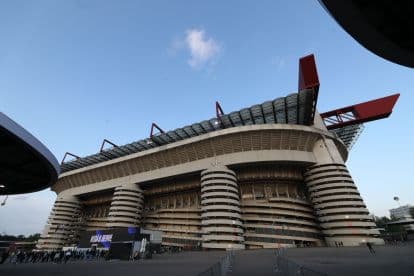
MILAN, ITALY – APRIL 21: A general view of the Giuseppe Meazza Stadium San Siro ahead of the Coppa Italia match between FC Internazionale and Como 1907 at San Siro on April 21, 2026 in Milan, Italy. (Photo by Marco Luzzani/Getty Images) How Serie A is Rebuilding its Media Strategy The Premier League’s model is difficult to replicate, so Serie A is taking a different approach. These are some noteworthy things it has been doing.
Moving Beyond Traditional Domestic Broadcasting Serie A can’t out-bid the Premier League on domestic rights value, not with Italy’s smaller pay-TV market and lower advertising spend. So, the league has increasingly embraced streaming. DAZN holds the main domestic package through 2029. It carries all Serie A matches, with seven games exclusive to the platform and three shown in co-exclusivity with Sky. That gives Serie A an important connection with the changing habits of sports viewers.
Football is no longer consumed only through traditional television. Fans increasingly watch on phones, tablets, computers and connected TVs. Streaming also creates more opportunities to collect audience data and understand viewing behaviour.
That does not automatically produce higher revenue. But it gives the league and its media partners more information about how fans consume the product.
International Distribution Is Becoming More Strategic The biggest change may be happening outside Italy. Direct international rights sales give Serie A more control over its global strategy. The league has worked with JPMorgan since 2025 to explore selling up to 49% of its international media rights division, which generates around €250 million a year. Reported interested parties include Apollo Global Management, CVC Capital Partners, Ares Management and Sixth Street. The goal is to bring in capital and expertise to grow overseas rights value faster than Serie A can manage alone, particularly in the US and Middle East, two markets the league has identified as priorities.
The League’s Global Brand Still Has Untapped Value Serie A has history, tactical prestige and some of the most recognisable clubs in world football. So, it doesn’t have to build its global brand from zero.
AC Milan, Inter, Juventus, Roma and Napoli already have large international followings. Italian football also has a strong historical identity.
The problem is converting that recognition into recurring revenue. A fan following a Serie A club on social media is valuable. But that value becomes much greater when the league can connect the audience to broadcast subscriptions, sponsorships, merchandise, digital content, and other products.
Digital Platforms Are Changing How Serie A Can Reach Fans Traditional broadcasting remains the main source of media revenue, but the way fans consume football is changing. Digital platforms give Serie A new ways to reach supporters, keep them engaged and potentially turn that attention into revenue.
Social Media Turns Clubs Into Global Media Brands Clubs no longer depend only on broadcasters to reach fans abroad. Juventus, Inter, Milan and Napoli all run active content operations across Instagram, TikTok and YouTube, publishing behind-the-scenes footage, player content and matchday build-up directly to global followers. This content doesn’t replace broadcast revenue, but it keeps the league visible in markets where TV distribution is weak or non-existent.
Direct-to-Fan Distribution Changes the Economics Traditional broadcasting puts a middle layer between the league and its audience. A broadcaster buys rights. The broadcaster then sells access to viewers. Direct-to-fan models change that relationship. A league can potentially sell subscriptions, memberships or premium content directly to supporters. It can also build a first-party database of its audience.
This model is still developing across football. Deloitte noted in 2026 that 2024/25 marked the first time a major European top-flight league commercialised its domestic media rights predominantly through a direct-to-consumer model, following the launch of Ligue 1+. Serie A does not need to copy that model immediately. But it gives the league another option as traditional television markets mature.
Streaming Opens New Distribution Opportunities DAZN’s expanding footprint has actually helped Serie A here. Beyond Italy, DAZN now holds Serie A rights in the UK, Ireland, France and the US, streaming matches directly to subscribers rather than through traditional pay-TV bundles. That gives Serie A access to younger, digital-first audiences the traditional broadcast model struggles to reach.
Commercial Partnerships Give Serie A Another Route to Growth Broadcasting creates the audience, but commercial partnerships help monetise it. Serie A’s growing international and digital reach gives sponsors more reasons to invest.
Global Sponsors Want Global Audiences Sponsors pay for reach. A brand looking for exposure across Asia, North America or the Middle East wants a league that shows up in those markets consistently. This is another reason Serie A’s push into international distribution matters commercially, not just financially. Broadcast reach and sponsorship value move together.
For example, BANCOMAT became an official Serie A partner for the 2024/25 and 2025/26 seasons. The agreement includes visibility during matches, digital channels and fan-focused initiatives.
Gambling and Casino Partnerships Italy’s Decreto Dignità has banned gambling sponsorship and advertising in domestic football since 2019, costing Serie A an estimated €100-150 million a year in lost revenue . Clubs found workarounds through “infotainment” deals with betting company subsidiaries, such as Inter Milan’s shirt partnership with Betsson Sport, which offers match content rather than direct gambling promotion. Reform talks began in 2025, with Italian lawmakers reviewing a proposal to lift the ban in exchange for a 1% revenue allocation from betting operators back into football. Outside Italy, casino review and affiliate sites such as https://automatenspielex.com/en are part of the wider online gambling marketing ecosystem that could become relevant to Serie A clubs if domestic advertising restrictions are relaxed.
The Bigger Commercial Opportunity If the ban lifts, Serie A clubs gain access to a sponsorship category that Premier League clubs have used for over a decade. It would not close the broadcast gap, but it would add a meaningful new revenue line at a time when domestic TV income has stalled.
ROME, ITALY – AUGUST 24: Donyell Malen with Paulo Dybala and Wesley Franca of AS Roma celebrates during the Serie A match between AS Roma and ACF Fiorentina at Stadio Olimpico on August 24, 2026 in Rome, Italy. (Photo by Paolo Bruno/Getty Images) 2 Strategic Routes for Serie A Serie A’s leadership faces a choice between two broad approaches, and the private equity talks suggest which way it is leaning.
Strengthen the traditional rights model: The league can focus on improving the value of domestic and international broadcast agreements. This remains the safest route because television and streaming rights still provide the largest predictable media revenues. Unfortunately, this has produced very limited growth for years. Build a hybrid model: Combine traditional broadcast deals with private capital, direct-to-fan digital revenue, and diversified commercial partnerships. This spreads risk across more revenue streams but requires giving up some control, as the JPMorgan-led talks show. The second route is more ambitious. It also fits the direction of the wider sports media market. Traditional television is not disappearing, but it is no longer the only way fans consume sport. Serie A, therefore, has little reason to choose between television and digital. It can use both.
New Revenue and Distribution Models Several models could help Serie A increase the value of its audience.
Direct-to-consumer streaming could allow Serie A to sell selected products directly to fans in markets where traditional rights have limited value. International digital partnerships could combine local platforms with Serie A content to build audiences in specific markets. Platform-specific content and sponsorship could turn social channels into additional commercial inventory. Data-driven commercialisation could allow Serie A and its clubs to demonstrate audience quality and engagement to potential sponsors. Can the Gap Realistically Close Serie A can narrow the gap with the Premier League, but closing it completely in the near term is unlikely. The difference is structural: the Premier League has a larger domestic media market, stronger international demand and globally recognised clubs that support high broadcasting and commercial revenues. Digital platforms and new distribution deals can help Serie A grow, but they cannot erase these advantages on their own.
The opportunity lies in getting more value from Serie A ‘s existing international audience. Direct rights sales, streaming, digital content and stronger commercial partnerships can increase revenue without trying to replicate the Premier League’s model. With distribution across more than 200 territories, Serie A already has significant global reach. The more realistic objective is to convert more of that audience into media and commercial revenue, reduce the financial gap over time and build a stronger financial base for Serie A clubs.
Source attribution: this article content is based on the linked publisher feed/source. Chance adds independent soccer context, impact analysis, entity links, and related news.
What happened
Serie A continues to trail the Premier League by approximately €1 billion in revenue, but is implementing strategies to close the gap. Key areas of focus include improving broadcasting rights deals, attracting higher foreign investment, expanding commercial partnerships in international markets — particularly in the US and Asia — and modernizing stadium infrastructure. Italian clubs are also exploring digital revenue streams and matchday experience improvements. While the gap remains significant, Serie A's growth trajectory and recent commercial initiatives suggest potential for sustained improvement in the coming years.
Chance analysis
The economic divide between Serie A and the Premier League is one of the defining structural challenges in European football, shaping everything from transfer market power to competitive depth in UEFA competitions. Closing even a portion of that gap would allow Italian clubs to retain top talent, compete more aggressively in the Champions League, and reassert Serie A's historical standing as a destination league. The strategies being deployed — from broadcasting reform to international market expansion — are a reminder that the modern game is as much a business battle as a sporting one. For fans, the implications are tangible: stronger finances translate to better players, better stadiums, and more compelling football.
Long-term: gradual improvement in Serie A's financial standing could strengthen clubs' transfer power and competitive depth in European competitions.