Italy's long-term challenge on the road to UEFA Euro 2032
Quick summary
An editorial analysis of Italy's national team planning and structural challenges as they prepare to co-host UEFA Euro 2032.
Full article
Attributed to original sourceItaly are going through a long transition period both on and off the pitch, and one of their long-term problems will go back to haunt them in the coming week, with big decisions expected ahead of Euro 2032.
Italy will co-host Euro 2032 with Turkey, but there’s still no certainty around which cities will host the competition in six years.
Italy’s ageing stadium infrastructure remains a major concern ahead of Euro 2032, with many venues requiring extensive renovations to sports stadium lighting , seating accessibility, hospitality areas, safety systems and overall fan experience to meet modern UEFA standards.
The Stadio Meazza in San Siro, Milan, has already failed UEFA tests, which means the Milan city council must identify a new arena to host the competition.
Milan and Inter have acquired the San Siro area and are planning to build a new stadium near the Meazza. However, the deal is under investigation by the Italian Financial Police, which is delaying any plans in place.
Turin, on the other hand, is quite confident of hosting the event thanks to Juventus’ Allianz Stadium.
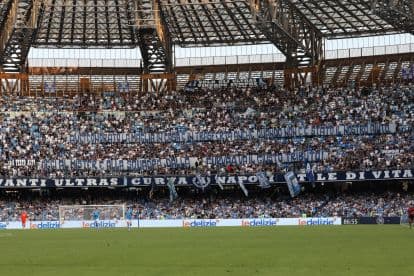
In Naples, the city council has approved refurbishment works to match UEFA’s requirements and host the event, while Napoli President Aurelio De Laurentiis hopes to build a new stadium elsewhere in the city. The same goes for Rome, with Roma’s owners working on a plan for a new stadium. At the same time, works will take place at the Stadio Olimpico to make it suitable for Euro 2032.
NAPLES, ITALY – MAY 24: SSC Napoli supporters during the Serie A match between SSC Napoli and Udinese Calcio at Stadio Diego Armando Maradona on May 24, 2026 in Naples, Italy. (Photo by Francesco Pecoraro/Getty Images) New FIGC President Giovanni Malagò spoke about the Euro 2032 challenge during a recent press conference: “I pushed myself past my concerns, I struggle to resist the call of Italian sport, and have many challenges, including the deadline of July 31 for the dossier of EURO 2032 stadiums,” he said.
“We have a six-year plan, building up to the European Championship that we are co-hosting, where we must try to recover the gap that is clear for all to see.”
UEFA’s Executive Director for Euro 2032, Michele Uva, said in April: “Italy will host Euro 2032 and will have its five host stadiums. There are no delays, and everything is on schedule. There is no cause for alarm. We simply need to keep working. At the moment, eight stadiums remain in contention. By the end of July, the Italian Football Federation will select five stadiums, plus two reserve candidates to submit to UEFA. The five final host venues will then he officially ratified during the first week of October.
TURIN, ITALY – MARCH 07: A detailed view of the corner flag inside the Juventus Stadium prior to the Serie A match between Juventus FC and Pisa SC at Juventus Stadium on March 07, 2026 in Turin, Italy. (Photo by Giuseppe Cottini/Getty Images) “We are talking about the third-largest sporting event in the world. It generates €3.5 billion in revenue and an overall economic impact of around €10 billion, shared among the ten host cities,” Uva added.
“There is an ongoing dialogue with the Italian government. We cannot afford to lose the European Championship, and I can say that we will not lose it. However, if the city of Milan does not build a new stadium, we will host the tournament without Milan. As things stand, San Siro does not meet the requirements to host a European Championship.
“If Milan and Naples fail to meet the required standards, they will not be included in the final bid dossier.”
Source attribution: this article content is based on the linked publisher feed/source. Chance adds independent soccer context, impact analysis, entity links, and related news.
What happened
The piece examines the broader structural and developmental challenges facing the Italian national team in the years leading up to UEFA Euro 2032, which Italy will co-host. It addresses long-term squad building, youth development pipelines, and the competitive landscape of European football. The article frames Italy's path not as a short-term tournament build-up but as a sustained project requiring strategic vision from the federation, coaching staff, and club system.
Chance analysis
For prediction systems, this is a low-urgency strategic outlook piece rather than actionable match intelligence. It signals the depth of Italy's rebuilding cycle and the gap between their Euro 2020 triumph and Euro 2032 hosting duties. The key takeaway is that Italy's competitive window for Euro 2032 will be defined by a generational transition, making their tournament prospects uncertain and dependent on youth integration over multiple seasons.
No immediate impact on upcoming matches; sets a long-term narrative framing Italy's trajectory toward Euro 2032.
Treat Italy as a team in long-term transition; their Euro 2032 co-hosting status may boost home advantage but squad quality is the bigger variable.