Juventus' sign-and-sell strategy with young Italian talents
Quick summary
Juventus continue their business model of acquiring promising young Italian players, developing them, and selling them on for profit.
Full article
Attributed to original sourceJuventus has been very active in the final days of June, especially in the Italian market.
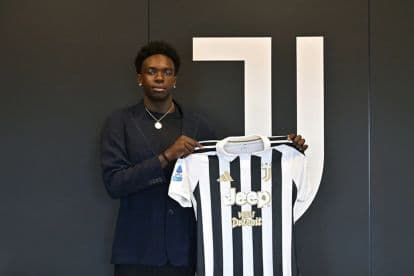
The Bianconeri have secured two agreements in the last few hours, sending 21-year-old goalkeeper Giovanni Daffara to Parma on a permanent €6m deal and signing Jeff Ekhator in a €18m transfer from Genoa. The agreement for Ekhator also includes David Puczka’s transfer to Genoa.
Juventus are rebuilding their team after failing to qualify for the Champions League in 2025-26, and even in a transition period, the odds already indicate that the Bianconeri among the favourites to win the Europa League in 2026-27 and the offers on BestBettingSites.co.uk make placing a bet a no brainer.
Both Ekhator and Daffara recently received their first senior Italy call-up under caretaker coach Silvio Baldini.
Jeff Ekhator has completed his transfer from Genoa (juventus.com)
Daffara did not make his debut against either Luxembourg or Greece, while Ekhator, 19, played his first international game at the senior level, starting against Greece.
Scorer of five goals in 57 games with Genoa, Ekhator already has considerable Serie A experience despite being still very young, and he can cover several roles in attack, from right and left winger to centre-forward.
It will be up to Juventus coach Luciano Spalletti to find the best position on the field for the promising Italian attacker.
Surely, Daniele De Rossi, the current Genoa coach and a former Roma player under Spalletti, is a big admirer of Ekhator as, this past April, he claimed : “Ekhator is growing before our eyes and is finally training like a true champion. Everyone has their own limits and timeline for reaching professional maturity, and he’s a young man who is well-liked by everyone. Physically, he possesses raw strength, outstanding agility and explosive power. It would be a serious mistake for a coach or a club to waste all that potential.
“He knows how to move, attack space, and make the most of his pace. What he needs now is consistency and stronger defensive tactical discipline. He’s working incredibly hard. In a few years, he’ll be worth tens and tens of millions of euros.”
TURIN, ITALY – MAY 24: Dusan Vlahovic of Juventus celebrates scoring his team’s first goal during the Serie A match between Torino FC and Juventus FC at Stadio Olimpico di Torino on May 24, 2026 in Turin, Italy. (Photo by Valerio Pennicino/Getty Images) Juventus remain on the lookout for another reinforcement in attack , especially after Dusan Vlahovic’s departure as a free agent at the end of his contract on June 30.
Multiple sources claim that PSG outcast Randal Kolo Muani remains the Bianconeri’s main target up front.
The Frenchman has now returned to Paris after a disappointing one-season loan spell at Tottenham, but has already scored 10 goals in 22 appearances at Juventus in 2024-25.
“Kolo is a possibility because the talk has gone on for a long time. You know there were previous difficulties, so we are rebuilding our rapport with PSG, but we also need the right and acceptable conditions,” Juventus director Giovanni Carnevali recently said.
“Concluding these talks is never easy. We have clear ideas, we know what we want to do and where we want to go.”
Source attribution: this article content is based on the linked publisher feed/source. Chance adds independent soccer context, impact analysis, entity links, and related news.
What happened
Juventus have built a well-known transfer strategy centered on identifying and signing talented young Italian prospects, integrating them into the squad or youth setup, and ultimately selling them at a significant profit. This approach balances immediate squad needs with long-term financial sustainability. The club's reputation for developing talent makes them an attractive destination for emerging players, while the sell-on model funds further investment in the first team.
Chance analysis
Juventus' sign-and-sell model with young Italian talents is both a financial and sporting strategy. It allows the club to maintain competitive squad depth while generating capital gains that can be reinvested in marquee signings. For prediction systems, this signals Juventus' continued reliance on a hybrid model — blending homegrown development with strategic trading — rather than purely top-down spending. Opponents should expect Juventus to rotate and develop youth, while transfer market watchers should anticipate regular sales of high-performing youngsters.
Juventus gain financial flexibility and squad depth through this strategy, but may face short-term sporting volatility as young players are cycled through.
Juventus' youth trading strategy means they may rotate emerging players more frequently and could be active sellers in upcoming transfer windows.