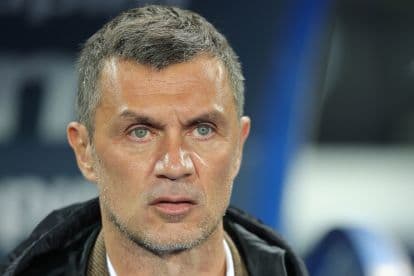
Maldini felt betrayed by Italian football: 'They don't want change'
Quick summary
Paolo Maldini has expressed deep frustration with Italian football, saying he felt betrayed and that the system resists change following his departure from his role.
Full article
Attributed to original sourcePaolo Maldini and Leonardo resigned after just 16 days in charge, following Giovanni Malagò’s refusal to hire Andrea Pirlo as Italy’s new coach: ‘They don’t want change,’ Maldini said, according to Corriere della Sera.
Maldini is no longer Italy’s technical director, as the ex-defender’s reign lasted only two weeks.
The final meeting between Maldini, Leonardo and Malagò
View this post on Instagram
A post shared by Football Italia (@gazzettafootballitalia)
He and his advisor Leonardo decided to step down on Monday after a long chat with FIGC President Malagò.
The latter tried to convince Maldini and Leonardo that Pirlo was not the most appropriate candidate to become Italy’s national team coach, pushing for either Antonio Conte or Roberto Mancini.
EMPOLI, ITALY – OCTOBER 01: Paolo Maldini of AC Milan looks on during the Serie A match between Empoli FC and AC MIlan at Stadio Carlo Castellani on October 1, 2022 in Empoli, Italy. (Photo by Gabriele Maltinti/Getty Images) Gazzetta adds that Maldini reluctantly informed Pirlo on Sunday night that he would not be chosen as Italy’s new coach.
Pirlo’s candidacy had caused controversy on a political level as the ex-midfielder is a brand ambassador for a Russian betting company, but it is believed that part of the FIGC, including Malagò, was not entirely convinced about giving him the job.
As reported by Corriere della Sera, Maldini felt betrayed as he thought that the political storm around Pirlo’s name was just an excuse not to appoint Pirlo.
Corriere, Gazzetta and Tuttosport claim that Maldini and Leonardo tried to propose Thiago Motta, but even the ex-Juventus and Bologna coach didn’t receive approval from Malagò, prompting Maldini and Leonardo to step down.
According to Corriere, Maldini and Leonardo left the meeting with a statement that reflects their thoughts on the situation: “They do not want change.”
BERGAMO, ITALY – FEBRUARY 16: AC Milan Sporting Strategy & Development Director Paolo Maldini and AC Milan Club Sporting Director Leonardo De Araujo before the Serie A match between Atalanta BC and AC Milan at Stadio Atleti Azzurri d’Italia on February 16, 2019 in Bergamo, Italy. (Photo by Marco Luzzani/Getty Images) REGGIO NELL’EMILIA, ITALY – MAY 18: Head coach of Juventus Andrea Pirlo speaks with the media during an Juventus press conference ahead of the TIMVISION Cup Final between Atalanta BC and Juventus on May 18, 2021 in Reggio nell’Emilia, Italy. (Photo by Claudio Villa/Getty Images for Lega Serie A) Repubblica reports that Maldini decided to resign after 24 hours of discussions with Malagò over Pirlo’s candidacy: “Pirlo was an unfortunate decision, but I am the president and, at this point, I take responsibility and I make the decision,” Malagò reportedly said.
At that point, Maldini and Leonardo realised that their decision-making authonomy was compromised and decided to step down.
Source attribution: this article content is based on the linked publisher feed/source. Chance adds independent soccer context, impact analysis, entity links, and related news.
What happened
Paolo Maldini, the former AC Milan and Italy legend, has opened up about feeling betrayed by Italian football's establishment. Speaking publicly, Maldini suggested that Italy's football culture is resistant to change, a sentiment that appears tied to his recent departure from his directorial role. His comments highlight ongoing structural issues in Italian football governance and modernization efforts. The remarks have sparked discussion about the country's reluctance to evolve compared to other major European leagues.
Chance analysis
Maldini's public criticism signals deeper dysfunction within Italian football's leadership and governance structures. His departure — likely from AC Milan's front office — removes a respected modernizing voice from the Italian game. For prediction systems, this is largely background context with no direct match impact, but it reflects ongoing instability at Italian clubs and may influence future management decisions.
Maldini's continued absence from Italian football leadership reinforces institutional inertia but has no direct effect on upcoming matches.
Maldini's departure and criticism are background context with no immediate match prediction impact for upcoming fixtures.