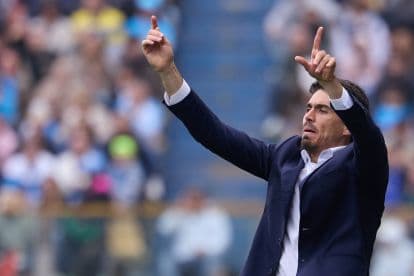
Parma: Better to fire Cuesta after a victory, Gilardino earned this chance
Quick summary
An opinion piece arguing that Parma should have waited to sack Carlos Cuesta until after a win, and that new manager Alberto Gilardino has earned his opportunity.
Full article
Attributed to original sourceParma CEO Federico Cherubini explains why they fired Carlos Cuesta, giving Alberto Gilardino his debut against Inter. ‘It was better to split when things were still going relatively well.’
It kicks off at San Siro at 17.00 UK time (18.00 CEST).
You can follow all the build-up and action as it happens from today’s three Serie A games on the Liveblog.
The Ducali make their debut under new coach Gilardino, having somewhat surprisingly sacked Cuesta during the long break for international duty.
It came after a 2-1 victory over Genoa, having scraped one point from the previous four rounds.
Parma explain Cuesta dismissal ITALY – APRIL 12: Carlos Cuesta, Head Coach of Parma Calcio reacts during the Serie A match between Parma Calcio 1913 and SSC Napoli at Stadio Ennio Tardini on April 12, 2026 in Italy. (Photo by Emmanuele Ciancaglini/Getty Images) “Last season we made a courageous decision in choosing Carlos, and even through many difficulties, we always found reasons to unite and overcome them,” Cherubini told DAZN Italia.
“This term we started in a slightly different way, and reacted differently to the same difficulties, so without that same sense of unity. So we believed it was better to split up when things were at least going relatively well, having finished last season positively and in Serie A.
“We made the change after a victory as well, because it was fairer not to wait for a bad result and make the most of that situation to take this action.”
ITALY – SEPTEMBER 14: Nesta Elphege of Parma Calcio 1913 is challenged by Jacobo Ramon of Como 1907 during the Serie A match between Como 1907 and Parma Calcio at Giuseppe Sinigaglia Stadium on September 14, 2026 in Italy. (Photo by Marco Luzzani/Getty Images) It has been another summer of intensive action on the transfer market, as Parma sell talent and try to launch new faces in Serie A.
“We are convinced that we created a more complete squad compared to previous years. We understand fans can be disappointed at losing important players every summer, but we have to think about the long-term project, combining sustainability with competitiveness. So far we have achieved that, and we hope to continue it with Gilardino.”
Alberto Gilardino of Genoa (Photo by Simone Arveda/Getty Images) Gilardino has returned to the Stadio Tardini after his playing experience for Parma, where he was the centre-forward from 2002 to 2005.
“We know full well that it’s difficult to emulate the Parma of the past, as the system has changed. We cannot take Parma being in Serie A for granted, and must also always look to grow our ambitions. This is the idea behind the choices we have made.
“Gilardino is very motivated. I’ve always liked Gilardino’s humility and relaxed aura. He is not here because he was a Parma player, but because of what he earned in a coaching career starting from the amateur teams, earning promotion to Serie A, and now being here,” assured Cherubini.
Source attribution: this article content is based on the linked publisher feed/source. Chance adds independent soccer context, impact analysis, entity links, and related news.
What happened
The editorial reflects on Parma's decision to part ways with head coach Carlos Cuesta, suggesting the timing was poor and that the club should have allowed him to taste victory before dismissing him. It frames incoming manager Alberto Gilardino as a coach who has earned his chance, highlighting his track record and suitability for the role. The piece situates the change within Parma's ongoing Serie A campaign and the pressure the club faces near the relegation zone.
Chance analysis
Parma's mid-season managerial change is being framed not as a panic move but as a transition that was handled at the wrong moment, with the suggestion that patience with Cuesta could have produced momentum before handing the reins to Gilardino. For readers, the key takeaway is that the club's identity under Gilardino is likely to lean on his reputation for structured, competitive football rather than wholesale tactical revolution. The story matters because it signals Parma's desperation to claw out of the lower half of Serie A and how the dressing room will need to respond to a third coaching voice this season.
Parma's change from Cuesta to Gilardino is likely to produce a short-term new-manager bounce but with tactical continuity rather than a dramatic reset.